
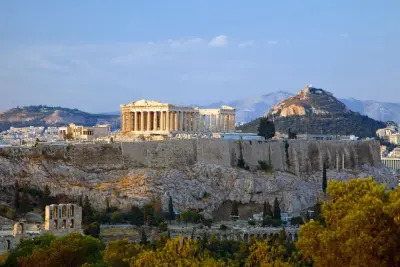
THE ARCHITECTURE OF THE ACROPOLIS
About Acropolis
The Acropolis of Athens is one of the world’s most recognizable ancient archeological sites. It is the best-known acropolis, which is a part of ancient Greek cities on the highest ground with the city’s main buildings. It has been inhabited since prehistoric times. The flat top of the hill is due to thousands of years of construction, dating back to the Bronze Age.

What was on the Acropolis before the monuments we see today?
There are no records of what happened on the Acropolis before the ancient people called the Mycenaeans showed up in the Bronze Age. It is believed that they built a walled compound for their leader. Later, there was a temple on the hill called the Bluebeard Temple, also dedicated to Athena, in the sixth century BC. It was called that because of a statue of a man-serpent that had three blue beards. Then, around 490 BC, the construction of the Old Parthenon started, but it was destroyed, as well as almost the whole Acropolis, in 480 BC when the Persians attacked. The Acropolis we can see today was built during the Golden Age of Athens when the city’s culture flourished under the leadership of Pericles.
Want to learn more about Acropolis?

Expert guide
Acropolis Guided Tour
Book this skip-the-line guided tour of Athens’s most iconic monument - the Acropolis. Your knowledgeable tour guide will take you on a journey through history. Explore the UNESCO-listed archaeological sites, and hear fascinating stories and myths of Ancient Greece. End your guided tour of the Acropolis with free time to further enjoy this incredible landmark at your own pace.

Priority access
Acropolis Skip-the-Line Ticket
Get priority entrance and walk around Acropolis Hill. Explore the Acropolis highlights at your own pace and discover UNESCO-listed archeological sites, including the Athena Nike Temple, the Dionysus Theater, and the Parthenon Temple.

30+ attractions
Athens Pass
Get the all-inclusive Athens City Pass to save money and time and explore Athens fully. Select from a 2- 5 day Pass and get priority entrance to the Acropolis Hill. You can choose from over 30 sights and attractions in Athens. Enjoy a Hop-On Hop-Off Bus Tour through the city streets, learn about Athens's history, and cruise to the islands.

PRIVATE TOUR
Acropolis Private Tour
Explore all of the most iconic sites Athens has to offer on this exclusive private tour! Discover the Acropolis, the Parthenon, and other famous sites accompanied by a licensed archaeological expert as your personal guide. Book the Acropolis Private Tour, get skip-the-line access, and feel like a VIP!
The architectural masterpieces on the Acropolis of Athens
The Acropolis of Athens is impressive because of the excellent integration of architecture to a natural site. The architectural masterpieces of the 5th century BC are the Parthenon, the Propylaea, the Temple of Athena Nike, and the Erechtheion.

The Parthenon
The Parthenon is a temple dedicated to the ancient Greek goddess Athena Parthenos, or Athena the Virgin. It was built as the main temple of Athena and served as the treasury of the Delian League, too. The Delian League was the confederacy of Greek states, founded in 478 BCE. One very interesting fact is that the corner columns of the structure were thickened to avoid the thinning effect when seen from some angles, which shows the genius and attention to detail of its builders. The metopes, or square panels on the exterior, represented battles between gods and giants, the so-called Gigantomachy; between humans and centaurs, or Centauromachy; Amazonomachy, a battle between the people of Athens and the Amazons; the fall of Troy, etc. The Parthenon was built using Pentelic marble from Mt. Pentelicus. A staggering 22,000 tons of it were used, which is more than any Greek temple up to that point! The stones were so skillfully cut that the building has stood on the Acropolis for over 2,000 years!

Propylaea & and the Temple of Athena Nike
Ancient Athenians entered the Acropolis through the Propylaea, which was designed to look like the Parthenon. It is one of only two buildings in Greek architecture to use metal as a structural aid. The other one is the Temple of Zeus at Agrigento. Once visitors to the Acropolis entered through the Propylaea, to their right was the Temple of Athena Nike, dedicated to Victorious Athena. The temple is recognizable by the colonnades on the front and back of the building, which are supported by four Ionic columns on each side. The structure was built on the edge of rock, with a drop on three sides. To prevent accidents, a famous 5th-century-BC sculptor, Callimachus, added a 1-meter-tall marble parapet. The temple was destroyed during Ottoman rule in the 17th century because they needed materials to build a defensive wall to protect themselves against the Venetians. The monument has been rebuilt a few times since then.

The Erechtheion
The Erechtheion is admired for its complexity and fine details. Its Ionic capitals are Greece’s most beautiful. The porch is supported by caryatid figures, columns shaped like draped women. According to a story, they represented women of Caryae, who had to endure hard labor because their town helped the Persians during their invasion. They were copied for the Pantheon, Hadrian’s Villa at Tivoli, the country residence of the Roman emperor, and other architectural projects. The marble used to build these monuments contains iron, which oxidized over time and gave them a beige color.
How was the Acropolis damaged?
Many unfortunate events happened during the centuries of history of the Acropolis. In the 17th century, the Turks fought the Venetians and kept ammunition in the Parthenon. The monument was then bombarded with cannonballs, and the ammunition exploded. Hundreds of men died, and the structure was damaged. In the 19th century, the Greeks fought for independence from the Turks, and the Acropolis was turned into a combat zone, which led to further damage. The Turks made bullets from the lead-coated iron clamps put in place to hold marble blocks together. Furthermore, the Acropolis was also damaged because of earthquakes, fire and looting.

The Restoration of the Acropolis
Multiple restoration projects took place on the Acropolis. One of them proved to be catastrophic. In the first half of the 20th century, an engineer by the name of Nikolaos Balanos supervised the restoration of the archeological site. The methods he used proved to be a disaster as the materials started to deteriorate and rust, which led to the stone suffering damage or cracking. The Committee for the Conservation of the Acropolis Monuments (ESMA) has been tasked with restoration projects since 1975. The goal is to make the monuments look as they did thousands of years ago as much as possible so future generations can appreciate the pinnacle of Classical Greek architecture and continue to be inspired by the achievements of the ancient Greek civilization.