
THE HISTORY OF THE ACROPOLIS
Acropolis History
The Acropolis is the main attraction and the centerpiece of Athens.

The Acropolis
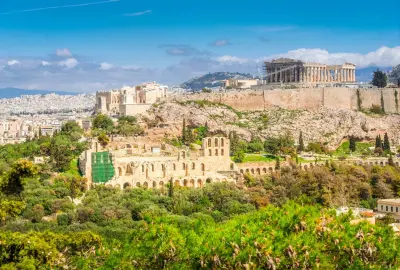
An acropolis was located on the highest ground in ancient Greek cities, and the main municipal and religious buildings were built here. The Acropolis of Athens was built in the 5th century BC in honor of Athena, the ancient Greek goddess who was considered the city’s patron.
What does the word “Acropolis” mean?
In Greek, “acro-” means high, and “polis” means city. So Acropolis means something like “high city” or “city at the top.” Ancient cities were built around high points for easier defense.

What buildings are located on the Acropolis?
The most famous one is the Parthenon, the main shrine to Athena and a treasury. The Temple of Athena Nike honored the goddess as the city’s protector. Another temple is the Erechtheion, a shrine to the agricultural gods. The gateway to the Acropolis was the Propylaea. On one of the slopes of the hill, the Odeum of Herodes Atticus was built. Herodes Atticus was a rich Roman and he built the odeum, or small theater, in the memory of his wife.
Who built the Acropolis?
In 480 BC, the Persians destroyed everything on the Acropolis. In 447 BC, Pericles gave the sculptor Phidias the task of restoring the Acropolis. The same year, he began building a shrine to Athena called the Parthenon. The temple was so big that there was a 12-meter-high statue of the goddess, holding a statue of Nike, the goddess of victory, in her hand. The other structures were built in the following years.

The Acropolis was a sacred place for many religions
The Acropolis wasn’t only a place of worship for the ancient Greek religion. The Byzantines made the Parthenon a Christian Church. A thousand years later, when Athens was under Turkish rule, the Parthenon was turned into a mosque.
The missing marbles
The Elgin Marbles is a collection of sculptures and architectural details taken from the Acropolis and exhibited in the British Museum in London. They were taken by Thomas Bruce, 7th Lord of Elgin, the British ambassador to the Ottoman Empire at the turn of the 19th century. This became a controversy as questions about the ownership of cultural artifacts were brought up. Lord Elgin did get permission from the Ottomans, who ruled Athens at the time, and did it because he was worried they would be destroyed. He took friezes and statues from the Parthenon and a caryatid, a column in the shape of a woman, from the Erechtheion, among other objects.

UNESCO’s World Heritage List
The Acropolis was added to the UNESCO World Heritage List in 1987. It is the most complete complex of ancient Greek monuments, important for its historical significance and the influence it has had on other buildings. It represents the peak of ancient Greek architecture.
The Acropolis Today
Despite earthquakes, explosions, fires, damage from World War II, and the removal of many parts of buildings and sculptures, the Acropolis is one of the most famous symbols of Greece today. Its ancient monuments still arouse the curiosity of millions of visitors every year, hundreds of years after they were first built.
Want to learn more about the Acropolis and its History?

Expert guide
Acropolis Guided Tour
Book this skip-the-line guided tour of Athens’s most iconic monument - the Acropolis. Your knowledgeable tour guide will take you on a journey through history. Explore the UNESCO-listed archaeological sites, and hear fascinating stories and myths of Ancient Greece. End your guided tour of the Acropolis with free time to further enjoy this incredible landmark at your own pace.

Priority access
Acropolis Skip-the-Line Ticket
Get priority entrance and walk around Acropolis Hill. Explore the Acropolis highlights at your own pace and discover UNESCO-listed archeological sites, including the Athena Nike Temple, the Dionysus Theater, and the Parthenon Temple.

Skip the line
Acropolis Museum Tour
Visit the Acropolis Museum and view famous historical treasures. Discover the excavations through the glass floor and learn from your licensed local guide about the history of this ancient Greek city.

ONE TICKET - 7 SIGHTS
Acropolis Pass and Combo Ticket
Make the most of your trip to Athens with a convenient combo pass. This ticket grants you access to the iconic Acropolis and up to 5 other ancient landmarks around the city. You can walk through the remains of the Ancient Agora, stand inside the Roman Agora, and see the impressive Temple of Olympian Zeus. The pass allows you to skip the regular ticket lines and manage your entries easily using a dedicated mobile application. Choose the option that fits your travel plans and see the best historical sites in Athens at your own pace!