
The lost Frankish Tower: The medieval giant that was “erased” from the Acropolis to create a false image of pure antiquity
The Lost Frankish Tower
The 600-year-old giant that vanished

The 600-year-old giant that vanished
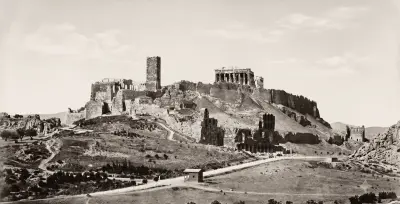
Looking at the Acropolis today, you probably can’t imagine a medieval knight’s castle sitting right on top of this ancient monument. However, the famous ruins you visit are actually a carefully edited version of history. From the 13th century until 1875, a massive, 26-meter-high (85-foot) stone tower stood right at the entrance.
It was built by Western European crusaders who conquered Athens and dominated the city’s skyline for over 600 years. When Greece gained independence, the government decided to erase all medieval structures at the Acropolis, leaving only pure antiquity. This towering piece of history was demolished in 1875, with funding from the archaeologist Heinrich Schliemann.

How a medieval castle landed in ancient Athens
If you are wondering how a medieval tower was built in the middle of the Acropolis, you have to look back to the aftermath of the Crusades. In the 13th century, Western European knights conquered the city and founded the Duchy of Athens. These wealthy rulers transformed the Acropolis into a heavily fortified stronghold, literally building the Frankish Tower on top of the ancient gates. Historians believe the De la Roche or Acciaioli families were responsible for turning the classical entrance into a working medieval palace. For hundreds of years, the Acropolis functioned as a classic European castle.

The Ottoman-era makeover
When the Ottoman Empire took control of Greece in the 15th century, the entire Acropolis was completely transformed into a bustling, crowded neighborhood. The iconic Parthenon was converted into a working mosque, complete with a tall minaret reaching into the sky. Meanwhile, the ancient Erechtheion temple was famously repurposed to house the local governor’s harem (although modern historians suspect this was just a myth inspired by the temple’s famous female statues). The Frankish Tower remained standing through all of this, keeping its role as a high-security prison and salt store. During this era, the Acropolis was a living, breathing community rather than a silent museum. For nearly 400 years, Greece remained under Ottoman rule, ending only after the Greek War of Independence in 1821.

A tower of many trades
Throughout its long life, the Frankish Tower served many different purposes for the city’s rulers. It was primarily used as a towering lookout point to spot incoming pirate ships or enemy armies. At times, the heavily fortified stone walls served as a secure vault for storing valuable treasures. Later, it was used as a military prison for prominent revolutionaries. Regardless of who ruled the city, the tower was a vital part of everyday Athenian life.

Making the Acropolis “pure” again
After winning independence in the 19th century, Greek leaders launched a radical campaign to remove all foreign influence from the Acropolis. Their goal was to destroy medieval, Byzantine, and Ottoman structures to manufacture a myth of pure, untouched antiquity. The Parthenon’s Ottoman additions were the very first casualties. By the mid-1840s, the government had completely demolished both the towering minaret and the small mosque built inside the ruins.
INTERESTING FACT
Millions of tourists walk through the site with absolutely no idea that a medieval castle or an Ottoman mosque ever existed there. However, if you look closely at the southwest corner of the Parthenon, you can still spot one historical scar. The internal base and stairwell of the demolished minaret are still structurally embedded in the southwest corner. It serves as a quiet, accidental reminder of the centuries of history that have been concealed.


The privately funded demolition
Despite surviving the Greek War of Independence as a military lookout, the Frankish Tower could not survive its fate. The broken Greek government could not afford to tear it down, so the wealthy German archaeologist Heinrich Schliemann paid 12,000 francs out of his own pocket to fund the demolition. Schliemann used this massive donation to gain the trust of the Greek authorities, helping him secure prestigious excavation permits at other historical sites in Greece. Schliemann considered the 600-year-old medieval giant an ugly eyesore that ruined his idealized ancient view of the hill. Despite considerable protests from international historians who condemned the act, the 85-foot-tall tower was completely erased by October 1875.

Finding the lost history on the hill
If you visit the Acropolis today, you can still find the physical footprints of the lost Frankish Tower. To see where it stood, look immediately to your right as you walk through the Propylaea, the main entrance gateway. The massive 85-foot tower was built directly into the south wing of this ancient structure. If you look closely at the marble walls, you can still spot deep cutting marks and architectural scars where the medieval stones were attached. For a deeper look, head to the modern Acropolis Museum at the foot of the hill. There, you can view medieval fragments, historic sketches, and artifacts that survived the 1875 demolition.

Not an isolated case
Many academics and archaeologists in the 19th and early 20th centuries were opposed to the tower’s destruction. Today, the academic consensus is that the destruction of the medieval and Ottoman layers of the Acropolis was a loss of historical data driven by nationalism rather than sound science. However, the destruction of the Frankish Tower is certainly not an isolated incident. All over the world, governments have frequently erased layers of real history to create a “perfect” version of the past. You can see the results of this controversial practice in famous monuments across Italy, Egypt, France, and many other places around the world. In each of these countries, leaders deliberately removed centuries of authentic heritage to isolate and highlight one specific ancient era. Ultimately, this proves that many of the historical sites we visit today were heavily edited and staged.
PRO TIP
Step inside the Acropolis and see the erased history for yourself. Join our Acropolis Guided Tour and explore the location where the Frankish Tower once stood. Let our local guides show you the real story of Athens!

The Venice Charter
The demolition of the Frankish Tower erased centuries of medieval history, serving as a stark reminder of the dangers of prioritizing one historical era while actively destroying another. Nearly a century later, the global architectural community united to prevent such tragic cultural erasures by adopting the Venice Charter of 1964. This important agreement changed how we protect monuments by declaring that the valid contributions of all eras must be respected. It strongly warned against stripping away authentic historical layers just to recreate an idealized past. If these protective rules had existed earlier, the Frankish Tower would probably still be standing today to tell the full, multi-layered story of Greece.
The complex legacy of an ancient site
The destruction of the Frankish Tower leaves us with a fascinating archaeological dilemma today. Was it right to completely wipe out centuries of medieval history just to “save” the ancient Greek monuments? Because of this 19th-century cleansing, millions of tourists now photograph a site that is heavily sanitized and curated. The next time you look at a postcard of the Acropolis, remember the lost stone giant. You are looking at a beautiful monument, but it is missing hundreds of years of its own true story.
Plan to visit the Acropolis soon?
Make sure to check out our Acropolis visiting guide first!

We have the best value Acropolis tours & tickets for you!

30+ attractions
Athens Pass
Get the all-inclusive Athens City Pass to save money and time and explore Athens fully. Select from a 2- 5 day Pass and get priority entrance to the Acropolis Hill. You can choose from over 30 sights and attractions in Athens. Enjoy a Hop-On Hop-Off Bus Tour through the city streets, learn about Athens's history, and cruise to the islands.

Greek myths & legends
Athens Mythology Tour
On the Athens Greek Mythology Tour, you will visit the sites where mythology meets history. Your guide will take you to the Theater of Dionysus, the Temple of Olympian Zeus, the Acropolis, and the ancient Agora. Don't miss an opportunity to discover the origins of Greek myths and their role in everyday people's lives. Book this tour now!

Expert guide
Acropolis Guided Tour
Book this skip-the-line guided tour of Athens’s most iconic monument - the Acropolis. Your knowledgeable tour guide will take you on a journey through history. Explore the UNESCO-listed archaeological sites, and hear fascinating stories and myths of Ancient Greece. End your guided tour of the Acropolis with free time to further enjoy this incredible landmark at your own pace.